
 PRODUCTS


 ARTICLE
 TH
TH EN
EN
Transform Your Traditional Warehouse into a Smart Warehouse
Invisible Warehouse Costs Are Draining Your Money
A warehouse without visibility is a warehouse that loses money every day. Staff waste time searching for misplaced goods, forklifts run non-optimized routes, products go missing, inventory counts are inaccurate, and no one really knows whether each forklift is being used to its full potential or not
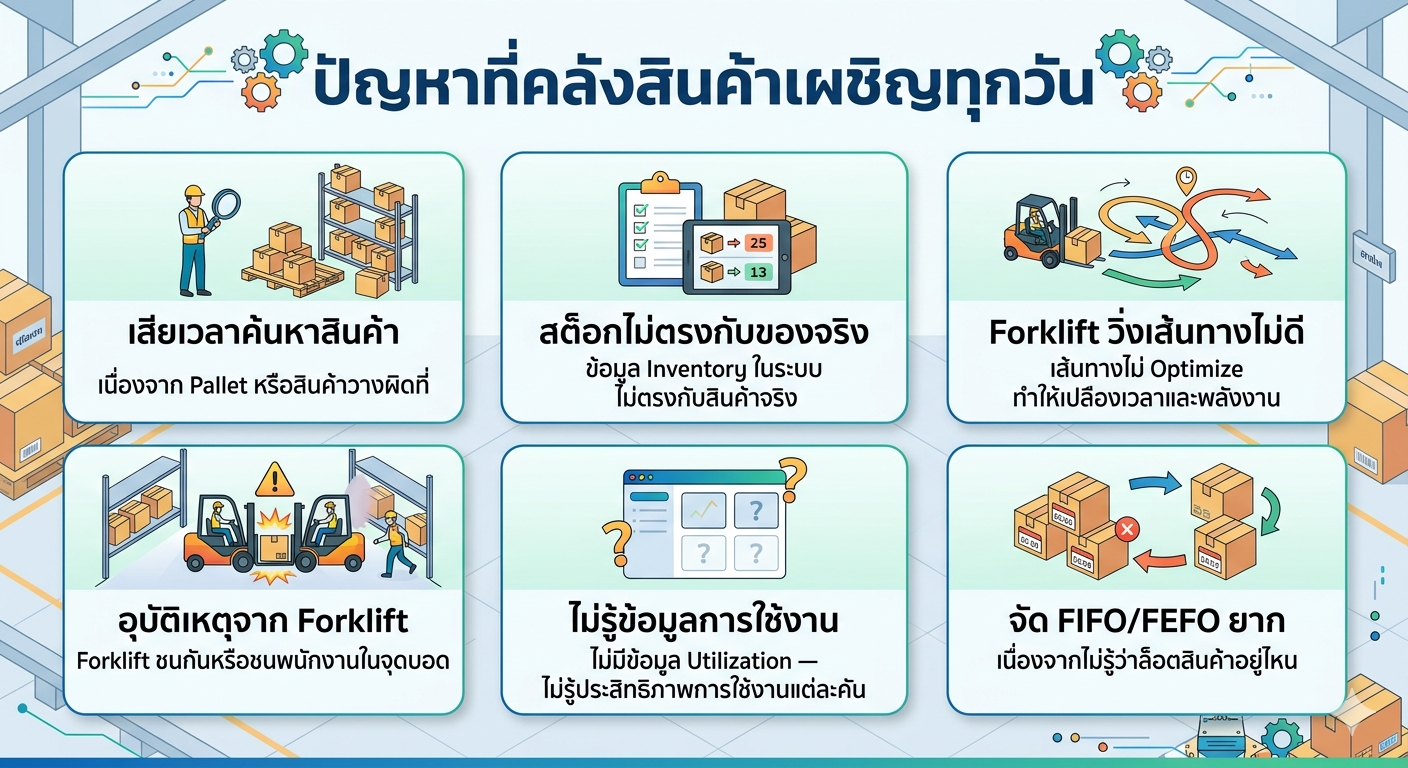
Indoor Location Tracking or RTLS (Real-Time Location System) solves these problems by providing real-time location data for goods, pallets, and forklifts, transforming an ordinary warehouse into a Smart Warehouse where every moving asset is visible.
What Is a Smart Warehouse?
A Smart Warehouse is a warehouse that uses IoT, RTLS, and Data Analytics for intelligent operations management. Its key features include:
○ Real-time Visibility — Know the location of goods, forklifts, and staff at every moment
○ Automated Data Collection — No need for manual barcode scanning; data updates automatically
○ Data-driven Decision Making — Make decisions based on real data, not guesswork
○ Proactive Alert — Receive automatic alerts when abnormalities occur, before problems escalate
And at the heart of a Smart Warehouse is location data generated by an Indoor Location Tracking system.
6 Ways to Use Indoor Location Tracking in Warehouses
1. Real-Time Product and Pallet Tracking (Inventory Tracking)
Instead of relying on barcodes that must be manually scanned every time, an RTLS system attaches tags to pallets or containers, allowing the location of every item to be tracked automatically at all times.
○ View every pallet location on a dashboard — just open the map to instantly see which rack and zone it is in
○ Reduce inventory count errors — automatic updates can reduce manual errors by up to 90%
○ Support FIFO/FEFO automatically — the system can identify which pallet arrived first and should be dispatched first
○ Alert when goods are placed in the wrong zone — prevent mixing of different product types
2. Forklift Tracking
Forklifts are the "lifeblood" of a warehouse. Tracking forklifts provides more than just location data:
○ Route Analysis — Use heatmaps to see which routes forklifts use most often, then optimize layout
○ Utilization Rate — Know the percentage of time each forklift is actually used, helping determine whether additional units are needed
○ Driver performance comparison — Identify which operator performs best and use that as a benchmark
○ Automated Inventory Update — When a forklift places a pallet in the assigned location, the system updates the WMS automatically
3. Collision Avoidance
Forklift accidents are among the most common dangers in warehouses, especially at blind spots and intersections:
○ Proximity Alert — Immediate alerts when a forklift gets too close to a worker or another forklift
○ Narrow Aisle Protection — In narrow aisles, only one forklift is allowed at a time
○ Speed Zone — Set zones where forklifts must slow down, such as intersections or loading areas
○ Near-miss recording — The system logs every near-accident event for analysis and risk reduction
4. Geofencing — Defining Virtual Zones
Geofencing means setting virtual boundaries on a warehouse’s digital map. When people or assets enter or leave a zone, the system automatically triggers actions:
○ Alerts when goods leave a designated zone — prevent loss or unauthorized movement
○ Restricted area access — only authorized forklifts or staff can enter designated zones
○ Auto Check-in/Check-out — Automatically record when pallets enter or leave a dock or storage zone
○ Temperature Zone Alert — Alert when cold chain products are removed from temperature-controlled zones
5. Yard Management — Outdoor Tracking
Many warehouses also have large yard areas that must be managed efficiently:
○ Know the location of waiting trucks — organize loading and unloading in a structured way
○ Automatic dock assignment — when a truck arrives, the system assigns the most suitable dock
○ Connect Indoor + Outdoor Tracking — use RTLS indoors and GPS outdoors, with all data on a single dashboard
6. Analytics & Optimization
Over time, accumulated location data becomes a "goldmine" for warehouse improvement:
○ Movement heatmaps — see which areas are heavily used and which are underutilized
○ Cycle Time Analysis — measure the time required for each process, such as Pick, Pack, and Ship
○ Layout Optimization — use real data to optimize warehouse layout as effectively as possible
○ Predictive Maintenance — schedule forklift maintenance based on actual usage hours, not just the calendar
Technologies Suitable for Warehouses
|
Use Case |
BLE |
UWB |
RFID |
Recommendation |
|
Pallet Tracking (Zone Level) |
Highly suitable |
More than necessary |
Acceptable (checkpoint-based) |
BLE — Best value |
|
Pallet Tracking (Rack Level) |
Usable |
Highly suitable |
Not suitable |
UWB — For high accuracy needs |
|
Forklift Tracking |
Usable |
Highly suitable |
Not suitable |
UWB — Route analysis + collision prevention |
|
Collision Avoidance |
Not sufficient |
Highly suitable |
Not suitable |
UWB — Requires real-time accuracy |
|
Geofencing |
Suitable |
Highly suitable |
Limited |
BLE or UWB depending on budget |
|
Yard Management |
Not suitable |
Not suitable |
Not suitable |
GPS + RTLS (Hybrid) |
|
Check-in/Check-out |
Suitable |
More than necessary |
Highly suitable |
RFID or BLE |
Recommendation for warehouses: Most warehouses begin with BLE for zone-level inventory tracking, then add UWB for forklift tracking and collision avoidance. If yard management is required, GPS can be added as a hybrid solution.
How Is RTLS Better Than Traditional Barcode and RFID?
|
Factor |
Barcode |
RFID (Passive) |
RTLS (BLE/UWB) |
|
Tracking Method |
Manual Scan |
Checkpoint-based |
Automatic real-time tracking |
|
Accuracy |
Requires point scanning |
1-10 m (via reader) |
cm to m (continuous) |
|
Labor |
Requires manual scanning |
Semi-automated |
Fully automated |
|
Data Available |
Location at scan point |
Passed / not passed checkpoint |
Location + route + time |
|
Human Error |
High |
Medium |
Very low |
|
Route Analysis |
Not possible |
Not possible |
Possible |
|
Collision Avoidance |
Not possible |
Not possible |
Possible |
Opportunities for Warehouses in Thailand
Thailand’s warehouse market is growing steadily, creating significant opportunities for Indoor Location Tracking adoption:
○ Strong e-commerce growth — increasing demand for highly efficient warehouses to handle larger order volumes
○ EEC and infrastructure development — development in the EEC is attracting investment in modern warehouses
○ High competition among 3PL providers — warehouse service providers must improve efficiency to stay competitive
○ Cold chain growth — refrigerated warehouses need both temperature and location tracking
○ Safety regulations — workplace safety requirements are becoming stricter
Measurable ROI
|
KPI |
Before RTLS |
After RTLS |
|
Pallet search time |
15-30 minutes per search |
A few seconds |
|
Inventory accuracy |
60-80% |
95-99% |
|
Forklift accidents |
Average X times/year |
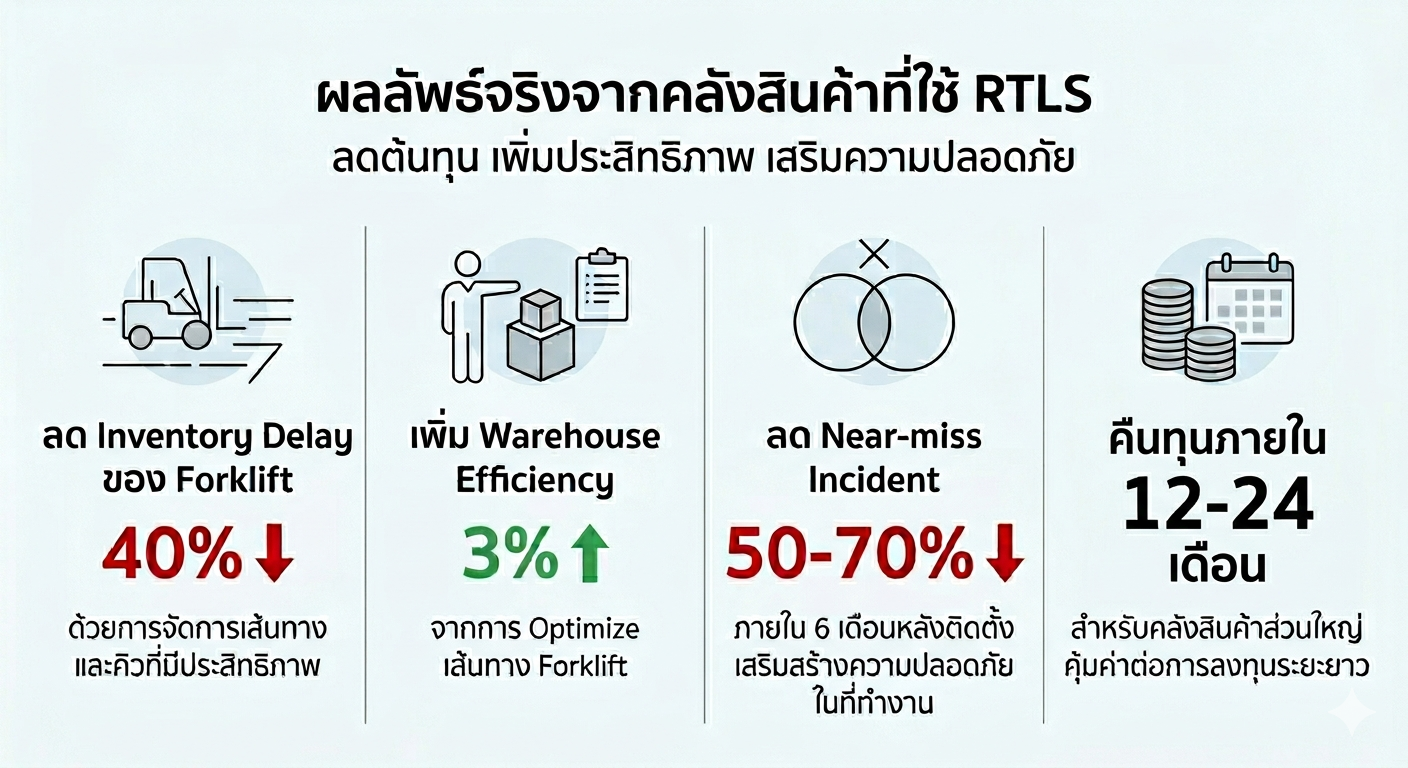
Reduced by 50-70% |
|
Forklift utilization |
No data |
Accurately measurable, improved by 20-30% |
|
Order processing time |
Slow (not optimized) |
20% faster |
|
Additional forklift rental/purchase cost |
Buy/rent more when capacity is insufficient |
Use existing assets to full capacity |
|
Manual scanning labor cost |
High (manual scanning required) |
Significantly reduced |
How to Get Started in a Warehouse
1. Select the first use case — Forklift Tracking is recommended because ROI is easiest to measure (fewer accidents, less search time, higher utilization)
2. Site Survey — Assess the area, warehouse size, rack height, and structures that may interfere with signals
3. Pilot Zone — Start with one zone, such as the inbound zone or the storage zone with the most issues
4. Connect to WMS — Integrate RTLS with the existing WMS via API so location data flows into the WMS automatically
5. Training — Train the operations team to use dashboards and alerts effectively
6. Measure and scale — Track pilot KPIs (search time, inventory accuracy, near-miss events) and then expand across the warehouse
Conclusion
Smart Warehouse is not just a trend. It is becoming a necessity for warehouses that need to compete in the age of e-commerce and increasingly complex supply chains. Indoor Location Tracking is the most practical first step in transforming a conventional warehouse into a Smart Warehouse.
From real-time inventory tracking and forklift tracking to accident prevention, geofencing, and yard management, everything begins with location data. With continuously decreasing costs and proven ROI, warehouses of all sizes can start today.
If your warehouse is ready to move toward becoming a Smart Warehouse, contact us for a free consultation, a live system demo, and a pilot plan designed to deliver results as quickly as possible.
Frequently Asked Questions (FAQ)
Q: If a warehouse is already using a WMS, does it need to change the system?
A: No. Modern RTLS solutions are designed to integrate with existing WMS platforms through standard APIs. Location data from RTLS flows into the WMS automatically, adding visibility to the current system without requiring a full replacement.
Q: Can warehouses with very tall racks still use this?
A: Yes. UWB can track both horizontally and vertically (3D positioning) when anchors are installed in suitable locations. It can identify which rack level a pallet is on and can even measure the fork height of a forklift.
Q: What kinds of tags can be attached to pallets?
A: There are many options, including adhesive tags, magnetic tags, strap-mounted tags, and even low-cost disposable paper tags. The right choice depends on the use case. For reusable pallets, permanent tags are appropriate. For pallets shipped to customers, paper tags are more suitable.
Q: How many months does it take to see ROI?
A: Most warehouses see ROI within 12-24 months. The use cases with the fastest ROI are typically forklift tracking (reducing accidents and idle time) and inventory tracking (reducing loss and scanning labor costs). It is best to start with a pilot project to validate actual numbers before scaling up.


