
 PRODUCTS


 ARTICLE
 TH
TH EN
EN
Transform into a Smart Hospital with Medical Equipment Tracking System
Imagine a nurse caring for a critical patient who urgently needs an infusion pump, but instead of providing immediate care, the nurse has to spend time searching from one floor to another because no one knows where the equipment is. This situation happens in hospitals every day, and its impact is greater than many realize.
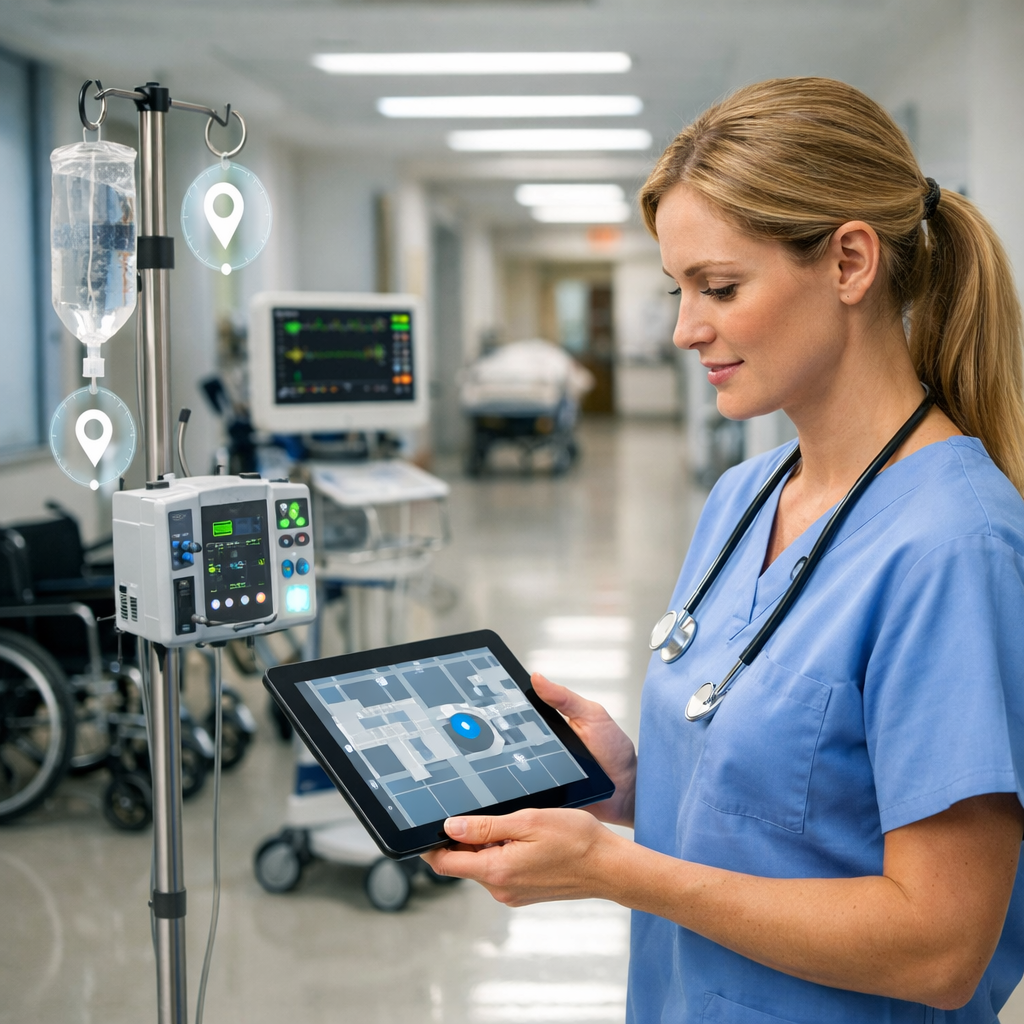
Shocking Statistics About Equipment Search in Hospitals
- Nurses spend up to 60 minutes per shift searching for equipment
- 10–20% of mobile equipment is lost or stolen over its lifetime
- Mobile equipment inventory counts are inaccurate by up to 60% in most hospitals
- IV pumps are actually utilized only 32% of the time (the rest are misplaced or hoarded and underused)
- 83% of hospitals still rely on manual tracking in some areas
These problems are not just about inconvenience. They directly affect the quality of patient care. When nurses spend time searching for equipment, the time they should spend with patients is reduced. In addition, hospitals end up purchasing more equipment than necessary, renting equipment at high cost, and losing revenue due to delayed services.
What Is Hospital Asset Tracking?
Hospital asset tracking is the use of RTLS (Real-Time Location System) technology in hospitals to automatically locate medical equipment, patients, and staff in real time. It eliminates the need for manual recording or phone calls to ask where items are. The system works by attaching small tags to medical devices that need to be tracked. These tags send signals to anchors/gateways installed throughout the building. The data is then processed and displayed on a dashboard or e-map that staff can instantly access on a computer or mobile device.
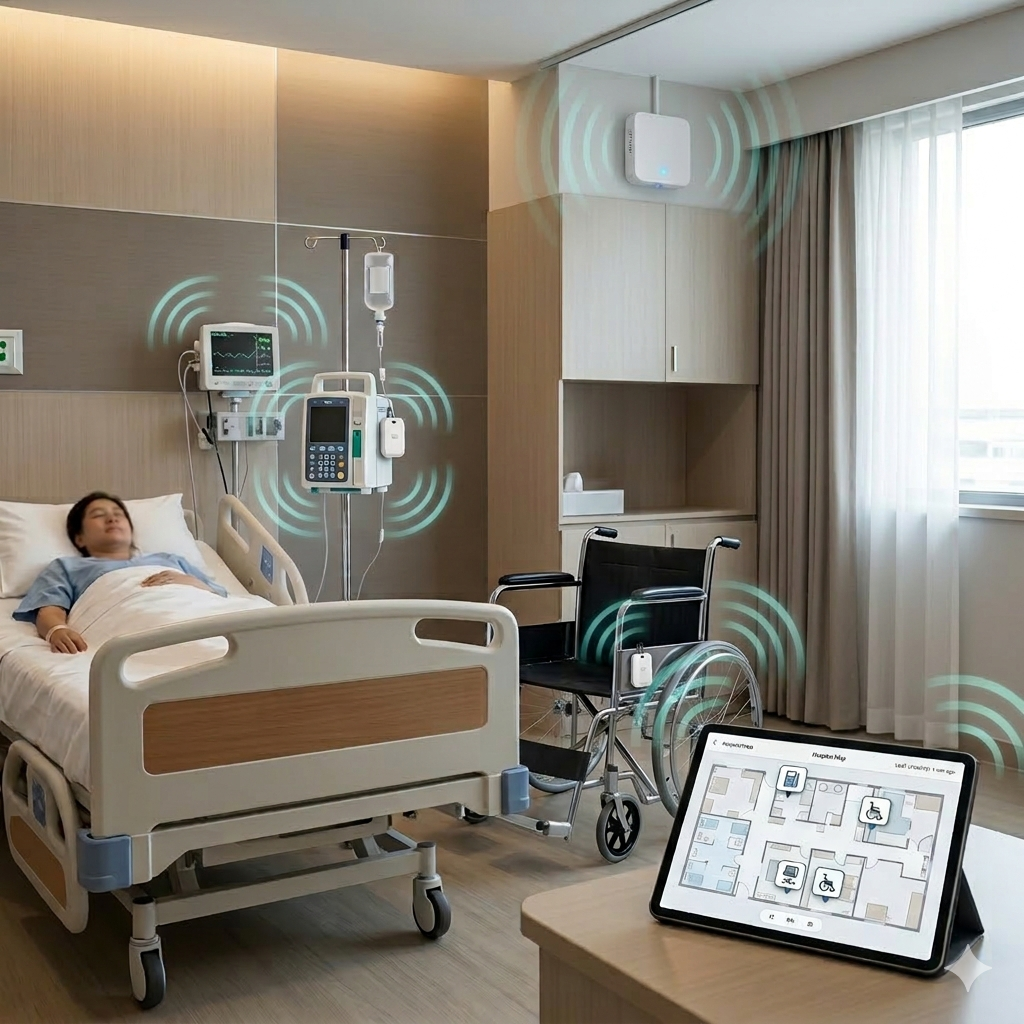
What Equipment Should Be Tracked?
Hospitals have hundreds to thousands of mobile assets that are moved between departments every day. The equipment that delivers the highest ROI when tracked is typically equipment that moves frequently and has high value:
|
Equipment Category |
Examples |
Why It Should Be Tracked |
|
Infusion Devices |
Infusion Pump, IV Pump |
Most frequently moved, low utilization rate, often “hoarded” |
|
Mobility Equipment |
Wheelchair, Patient Bed, Stretcher |
High quantity, frequently moved between floors, commonly hard to find |
|
Diagnostic Devices |
Portable X-ray, Ultrasound, Monitor |
High value, shared across multiple departments |
|
Life-Saving Equipment |
Ventilator, Defibrillator, AED |
Must be immediately available during emergencies |
|
Surgical Equipment |
Surgical Tools, Instrument Tray |
Need to know both location and status (clean/used) |
It is recommended to start with the equipment that staff spend the most time searching for, which is usually infusion pumps, wheelchairs, and patient monitors, as these typically deliver the fastest ROI.
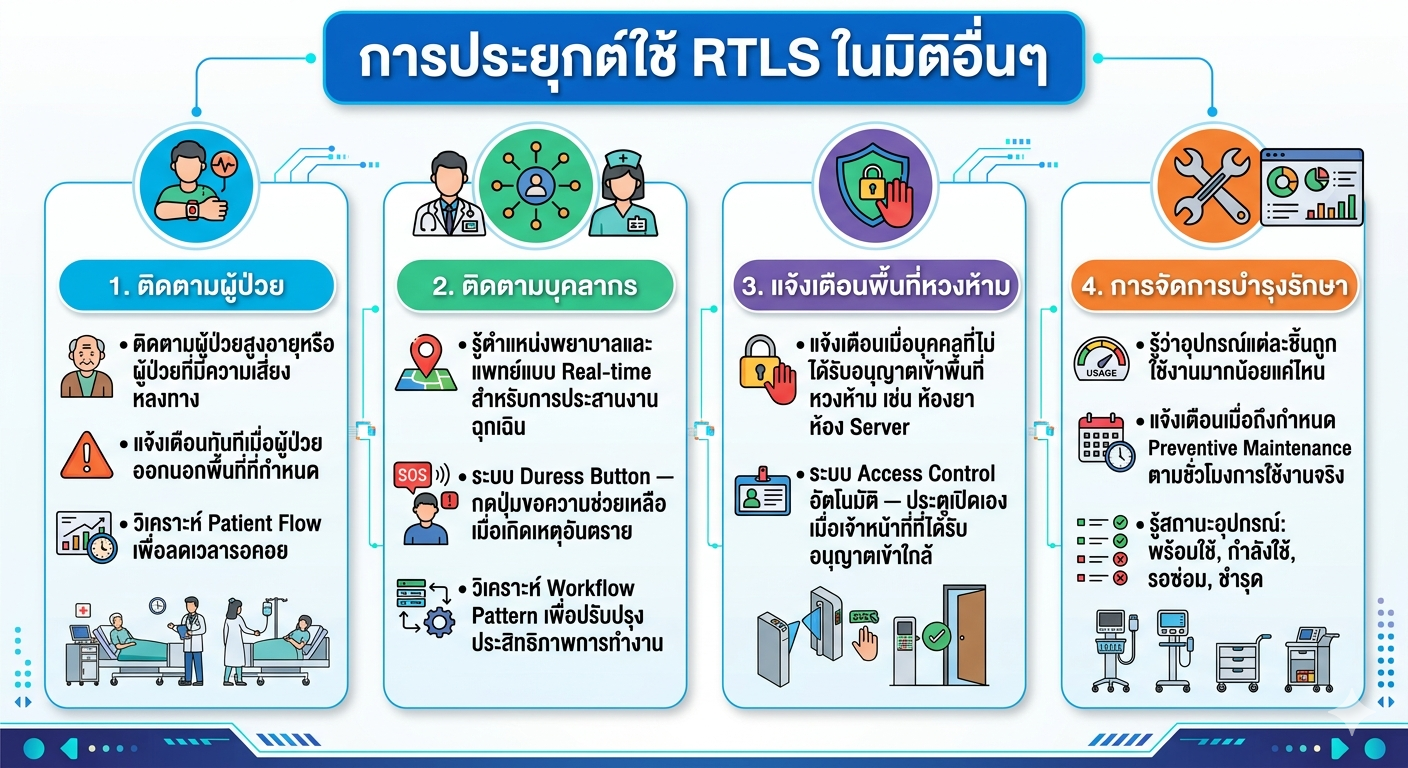
Other Applications of RTLS
RTLS in hospitals does much more than just locate equipment. Once the infrastructure (anchors/gateways) is installed, the system can be expanded into many other applications:
1. Patient Tracking
- Track elderly patients or patients at risk of wandering (Wandering Prevention)
- Instant alerts when patients leave designated areas (Geofencing)
- Prevent infants from being taken from the hospital (Infant Security)
- Analyze patient flow to reduce waiting times
2. Staff Tracking
- Know the real-time location of nurses and doctors for emergency coordination
- Duress Button system — press for help in dangerous situations
- Analyze workflow patterns to improve operational efficiency
3. Restricted Zone Alert
- Alerts when unauthorized individuals enter restricted areas such as medication rooms or server rooms
- Automatic access control system — doors open automatically when authorized staff approach
4. Maintenance Management
- Know how much each piece of equipment is being used (Utilization Data)
- Alerts when preventive maintenance (PM) is due based on actual usage hours
- Know equipment status: available, in use, awaiting repair, out of service
Which Technology Is Best for Hospitals?
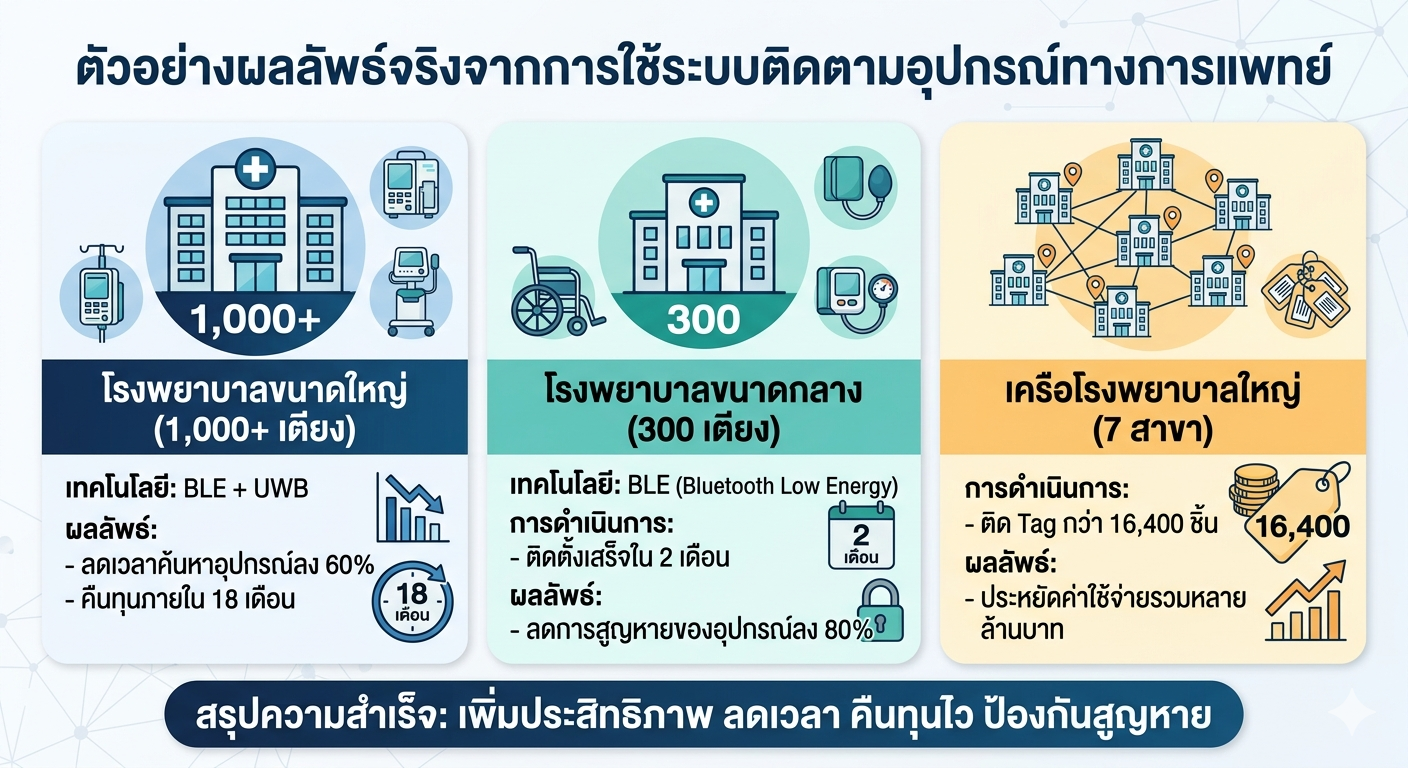
For hospitals, the most commonly used technology is BLE (Bluetooth Low Energy) because it is cost-effective, easy to install, and uses low-power tags. However, some hospitals choose a hybrid approach by adding UWB in areas that require higher accuracy:
|
Area |
Recommended Technology |
Accuracy |
Reason |
|
General Areas (Ward, OPD) |
BLE |
1–3 meters |
Cost-effective and suitable for wide coverage |
|
Operating Room (OR) |
UWB |
10–30 cm |
Requires very high precision |
|
Emergency Room (ER) |
BLE + UWB |
Sub-meter |
Equipment must be located as quickly as possible |
|
Central Equipment Storage |
BLE |
Room-level |
Know whether equipment is in storage or not |
|
Entry / Exit Points |
RFID / BLE |
Checkpoint-level |
Prevent equipment from leaving the building |
Many hospitals choose to start with BLE across the system, then later add UWB where needed, because the infrastructure (network, server) can be shared.
Measurable ROI
Investing in RTLS for hospitals is not just a “nice to have.” It is an investment with clear and measurable returns:
Cost Savings
○ Reduce unnecessary equipment purchases — hospitals using RTLS often discover that up to 20% of their inventory was already available but previously unaccounted for
○ Reduce equipment rental costs — hospitals of all sizes can significantly lower rental expenses by fully utilizing the equipment they already own
○ Reduce loss and theft — the system sends alerts when equipment leaves designated areas
Improved Efficiency
○ Reduce equipment search time — from 30–60 minutes per shift to just a few seconds by opening the dashboard and viewing the location
○ Increase equipment utilization — hospitals using RTLS can raise IV pump utilization from 32% to 65%
○ Nurses have more time for patient care — time previously lost searching for equipment can instead be spent with patients
How to Get Started
1. Define your goal — what do you want to track? Equipment, patients, or staff? Start with the use case that delivers the fastest ROI
2. Conduct a site survey — assess building size, structure, materials that may interfere with signals, and the existing network system
3. Choose the technology and provider — BLE for cost-effectiveness, UWB for high accuracy, or hybrid for both
4. Run a pilot project — start with one department (such as ER or the ward with the most issues) to test the system and measure ROI
5. Train staff — explain how to use the dashboard, search for equipment on the map, and manage alerts
6. Scale the system — once the pilot is successful, expand to other departments and add more use cases such as patient tracking and staff safety
What to Consider Before Making a Decision
- Signal safety: BLE and UWB tags operate on frequencies that do not interfere with medical equipment (FCC certified), so there is no need to worry about signal interference
- Integration with HIS/EMR: choose a system that can connect with the hospital’s existing systems such as HIS, CMMS, or Nurse Call
- Privacy: staff tracking requires a clear privacy policy and proper communication so employees understand how the system is used
- Change management: the biggest challenge is not the technology, but changing staff behavior. Hospitals need clear communication of benefits and sufficient training
- Scalability: choose a system that can easily expand with more tags and additional use cases in the future without changing the infrastructure
Summary
Hospitals of all sizes face the same problems: time wasted searching for equipment, lost assets, low utilization rates, and staff with too little time for patients. RTLS for hospitals addresses these challenges in a practical way by providing real-time location data for equipment. It helps reduce costs, improve efficiency, and most importantly, gives staff more time to care for patients.
With BLE technology costs continuing to decline and ROI clearly proven, 2026 is the best time for hospitals to get started.
If your hospital is interested in a hospital asset tracking system, contact us for a free consultation, live system demonstration, and support in planning a pilot project together.
Frequently Asked Questions (FAQ)
Q: Are tags attached to medical equipment safe? Do they interfere with medical devices?
A: Yes, they are safe. BLE tags and UWB tags comply with FCC standards and use very low transmission power, so they do not interfere with medical devices. Large hospitals around the world have been using them for years without any problems.
Q: Do we need additional cabling?
A: In most cases, no. BLE anchors can connect through the hospital’s existing Wi-Fi or LAN. Anchors are typically installed on ceilings or walls, and a medium-sized hospital can usually complete installation in about 2 months.
Q: How will patients feel about wearing a tag?
A: Patient tags are usually lightweight, waterproof wristbands, so patients barely notice they are wearing them. For elderly patients at risk of wandering, families often feel more reassured knowing that there is a safety system in place.
Q: Where should we start?
A: It is recommended to start with a pilot in the department facing the biggest challenge, such as the emergency room (ER) or a ward with many infusion pumps. Begin by tagging the equipment that is most frequently misplaced, then measure ROI based on the time saved. Once results are proven, expand to other departments.


