
 PRODUCTS


 ARTICLE
 TH
TH EN
EN
Unlock Smart Factory 4.0 with Real-Time Indoor Location Tracking
When people talk about Industry 4.0, many think of robots, automation systems, or AI. But there is another essential element that is often overlooked: “knowing the real-time location of everything inside the factory.”
This article takes a deep dive into how Indoor Location Tracking helps elevate factories into Smart Factories, from production line tracking and accident prevention to creating a digital twin of the factory.
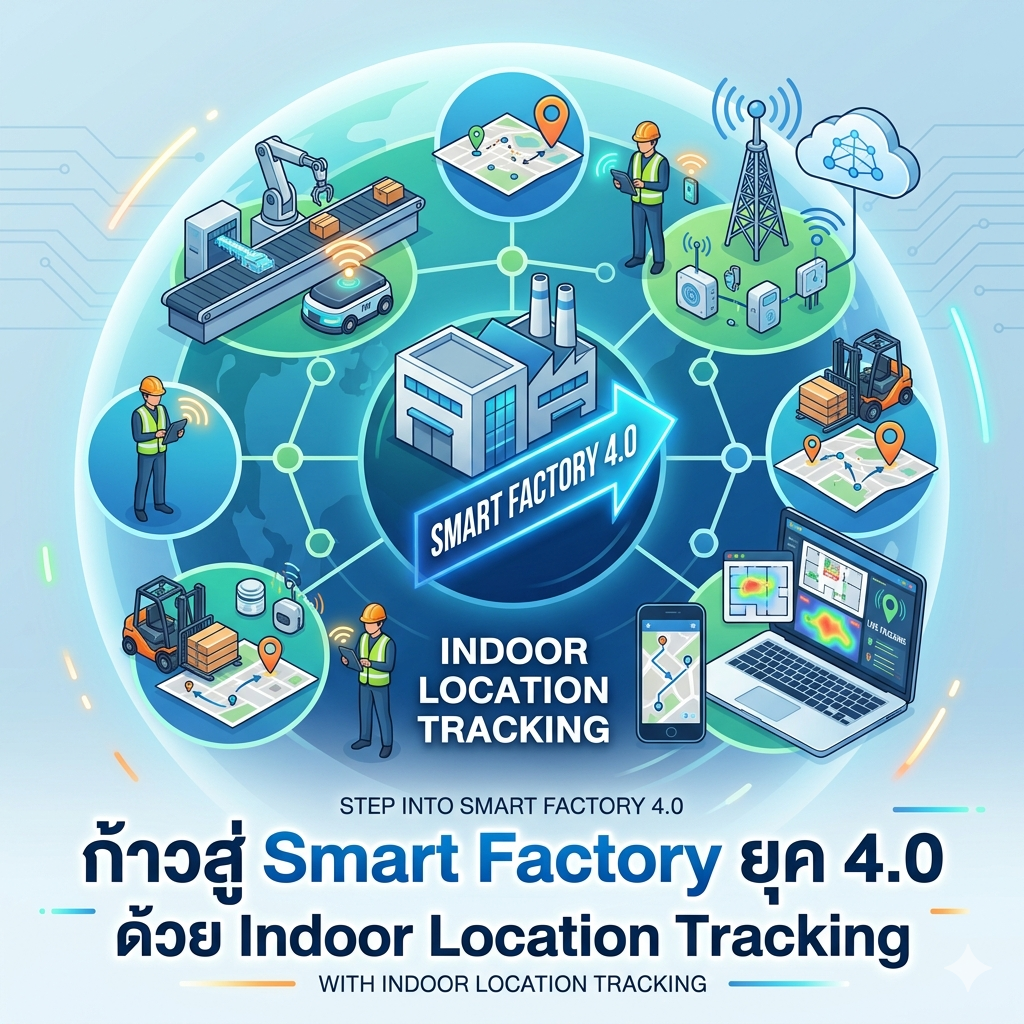
What is Industry 4.0?
○ The Fourth Industrial Revolution focuses on integrating IoT, AI, Big Data, and Automation
○ The goal is a factory that can “think for itself,” where machines can communicate and make decisions without waiting for human instructions
○ RTLS is one of the foundational technologies that cannot be overlooked, because it provides the location data required for automated decision-making
○ 75% of manufacturers expect RTLS to become a standard technology in factories by 2028
7 Ways to Use Indoor Location Tracking in Factories
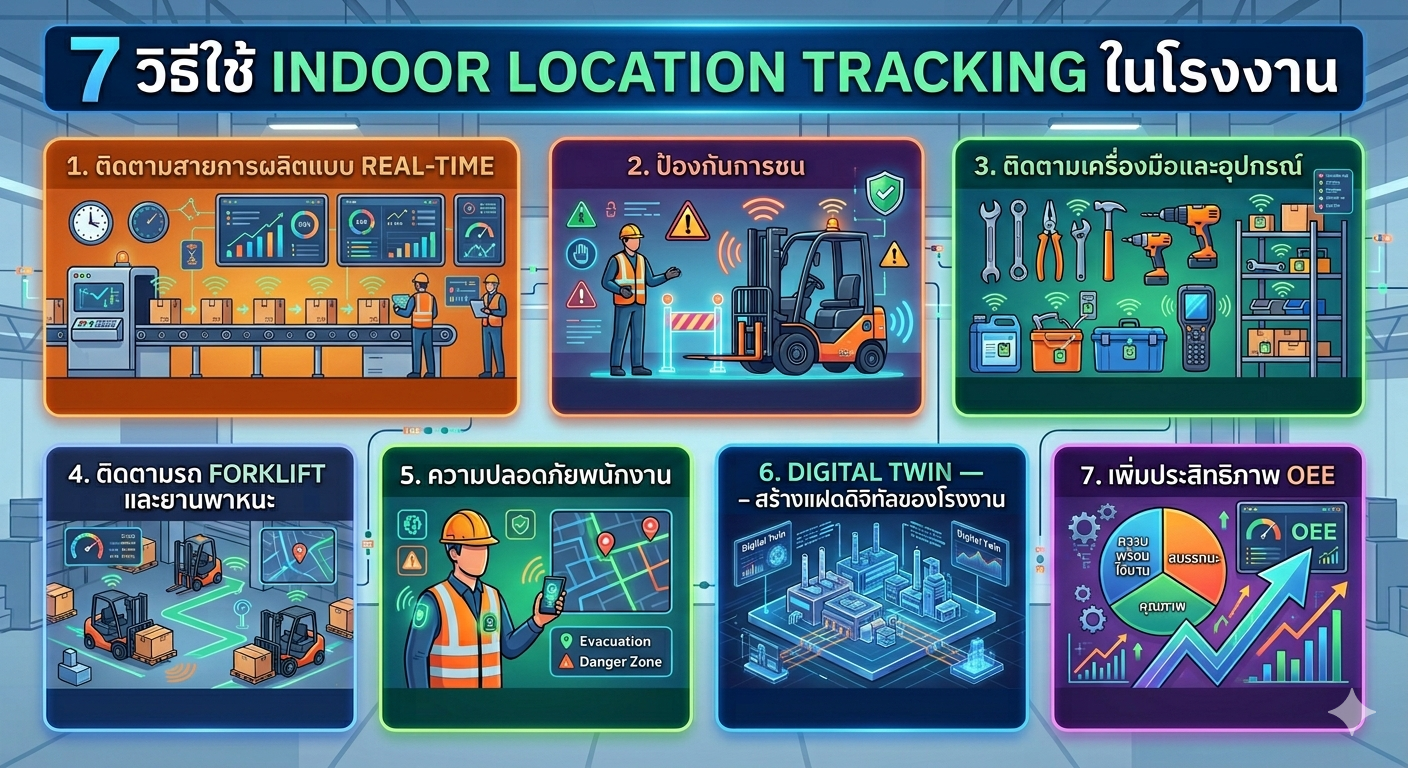
1. Real-Time Production Tracking
This is one of the most powerful use cases. It allows you to know exactly which stage each workpiece is in on the production line in real time, without manually scanning barcodes. The system works by attaching tags to assembly trolleys or pallets. When a workpiece moves through a virtual zone (geofence) defined for each production step, the system automatically records that the step has been completed and the next step can begin immediately.
○ Reduces manual barcode scanning, saving time and reducing human error
○ Provides real-time job status with a complete overview of the production line on a dashboard
○ Sends alerts immediately when a workpiece remains in any step longer than the defined limit
○ Enables traceability by showing which steps each workpiece passed through, when, and how long each step took
2. Collision Avoidance
Accidents involving forklifts hitting workers are among the most common and dangerous accidents in factories. Indoor Location Tracking, especially UWB with centimeter-level accuracy, can help prevent them by:
○ Providing real-time alerts — when a forklift approaches a worker within a danger zone, tags can warn both the driver and the worker (sound/vibration/light)
○ Creating automatic safety zones — defining hazardous areas where forklifts must slow down or stop automatically
○ Recording near-miss events — the system logs every near-accident for future analysis and prevention
3. Tool & Asset Tracking
Factories have many expensive specialized tools that are constantly moved between production lines. Not being able to find a tool can mean stopping the production line, which carries a very high cost.
○ Know the real-time location of every tool on a dashboard
○ Receive alerts when tools leave designated areas
○ Analyze utilization rates to plan additional purchases or reallocation
○ Reduce search time by up to 90%
4. Forklift and Vehicle Tracking
Tracking forklifts provides benefits beyond simply knowing where they are:
○ Route analysis — view heatmaps of the most frequently used forklift paths to optimize factory layout
○ Reduce bottlenecks — identify points where forklifts spend too much time waiting and improve the process
○ Calculate utilization rates — know how much each vehicle is actually used to decide whether more are needed
○ Perform maintenance based on actual usage — trigger PM based on real operating hours, not just the calendar
5. Worker Safety
Safety is non-negotiable in factories. Indoor Location Tracking enhances worker safety in many ways:
○ Hazardous area geofencing — instantly alerts when unauthorized workers enter dangerous zones
○ Mustering point management — during an emergency, instantly know how many workers are inside the building and who has not yet evacuated
○ Lone worker protection — detects when a worker operating alone remains motionless for an unusually long time
○ Duress button — workers can press an emergency help button on the tag and send their location immediately
6. Digital Twin — Creating a Virtual Twin of the Factory
A digital twin is a virtual model of the factory on a computer that shows the location and status of everything in real time. RTLS data is at the core of bringing a digital twin to life:
○ See the entire factory on a real-time 3D map
○ Simulate layout changes before implementing them in the real world
○ Analyze what-if scenarios such as “What happens if we add another production line?”
○ Enable management to monitor factory status from anywhere, at any time
7. Improving OEE
OEE or Overall Equipment Effectiveness is one of the most important performance indicators in manufacturing, consisting of Availability, Performance, and Quality. Implementing Indoor Location Tracking helps improve all three dimensions:
○ Availability — reduces downtime caused by searching for tools and materials
○ Performance — reveals bottlenecks in real time so improvements can be made immediately
○ Quality — verifies that every workpiece has passed through all required steps without skipping any stage
Technologies Suitable for Factories
The factory environment presents unique challenges for indoor tracking systems because there is a large amount of metal, dust, heat, and machinery that may interfere with signals. The recommended technology depends on the specific requirement:
|
Use Case |
Recommended Technology |
Reason |
|
Production Tracking |
UWB |
Requires high accuracy to know exactly which production step the item is in |
|
Collision Avoidance |
UWB |
Requires real-time tracking with centimeter-level accuracy |
|
Tool & Asset Tracking |
BLE or UWB |
BLE is sufficient for zone-level visibility, while UWB is better when precise positioning is required |
|
Forklift Tracking |
UWB |
Supports route analysis and collision prevention |
|
Worker Safety |
UWB + BLE |
UWB for safety zones, BLE for duress buttons |
|
Digital Twin |
UWB |
Requires accurate location data for 3D modeling |
|
OEE Monitoring |
BLE or UWB |
Depends on the level of detail required |
For factories that require high accuracy, UWB is the leading choice because it is more resistant to signal interference in metal-heavy factory environments and delivers 10–30 cm accuracy.
For use cases that do not require very high precision, BLE is a more cost-effective option.
Opportunities for Factories in Thailand
Thailand has several favorable factors supporting the adoption of Indoor Location Tracking in factories:
○ Thailand 4.0 and EEC policies — the government supports digital technology adoption in industry and offers tax incentives for technology investment
○ Automotive and electronics industries — Thailand is a major production base that needs to upgrade to Smart Factory capabilities to remain competitive in the region
○ Stricter safety regulations — increasing factory safety requirements make worker tracking more important
○ Lower technology costs — both BLE and UWB continue to become more affordable, allowing even mid-sized factories to adopt them
○ Support centers such as SMC (NECTEC) — government-backed organizations are helping drive Thai factories toward Industry 4.0
How to Get Started for Factories
1. Choose the first use case with the fastest ROI — Forklift Tracking or Tool Tracking is recommended because the results are easy to measure (less search time, fewer accidents)
2. Site Survey — inspect the factory area, evaluate structural materials, identify metal-heavy zones, and determine suitable anchor installation points
3. Pilot in a small area — start with one production line or one zone to test the system and measure results
4. Integrate with existing systems — connect RTLS data with the factory’s ERP, MES, or SCADA through standard APIs such as MQTT, OPC UA, and Modbus
5. Measure results and expand — calculate ROI from the pilot, then scale to other use cases, for example starting with Tool Tracking and adding Production Tracking later
Expected ROI
|
Metric |
Before RTLS |
After RTLS |
|
Tool search time |
30–60 minutes per search |
A few seconds (90% reduction) |
|
Forklift accidents |
Average X times/year |
Significantly reduced |
|
OEE |
Lack of visibility |
Real-time visibility into bottlenecks |
|
Machine utilization rate |
No data |
Measurable and accurate |
|
Production line cycle time |
Measured manually (inaccurate) |
Measured automatically with 100% accuracy |
|
Downtime caused by searching for tools |
High |
Nearly zero |
Conclusion
A Smart Factory does not mean you must immediately invest heavily in robots or AI. Starting with Indoor Location Tracking is one of the most cost-effective and fastest ways to move toward Industry 4.0, because it gives the factory “eyes” — the ability to see everything moving inside the plant in real time.
From tracking production lines and preventing accidents to locating tools and creating a digital twin, everything begins with location data, and RTLS is the key that unlocks these capabilities.
If your factory is ready to move toward a Smart Factory, contact us for a free consultation, a live system demo, and a pilot plan designed to deliver the fastest ROI.
Frequently Asked Questions (FAQ)
Q: Will signals be a problem in factories with a lot of metal?
A: UWB is designed to perform well in metal-rich environments because it uses a specific frequency range and short pulses that are resistant to multipath interference. Automotive and aerospace factories around the world widely use UWB RTLS.
Q: Do we need to stop the production line for installation?
A: No. Anchors are installed on ceilings or elevated structures, so they do not interfere with active production lines. Tags can also be attached to equipment without stopping the machines.
Q: Can it connect with ERP or MES?
A: Yes. Modern RTLS systems support standard industrial protocols such as MQTT, OPC UA, Modbus TCP, and RESTful API, allowing integration with ERP, MES, SCADA, or Power BI systems already used in the factory.
Q: How many months does it take to see ROI?
A: It depends on the use case. In general, Asset Tracking and Forklift Tracking can show ROI within 6–12 months, while Production Tracking may take 12–18 months to show its full impact. It is recommended to start with a pilot project to validate the numbers before scaling up.


