
 PRODUCTS


 ARTICLE
 TH
TH EN
EN
Lean Production
Lean Production is not merely a set of tools for “organizing the shop floor.” It is a production management approach aimed at reducing waste, improving delivery capability, and increasing process stability through clear standards. From the perspective of executives and factory managers, Lean success must be reflected in measurable indicators that can be tracked and systematically expanded upon.
This article summarizes Lean Production in the context of factories in Thailand, with a focus on management thinking, a practical 30–60 day starting plan, and the KPIs that should be used to drive continuous improvement as an operating system, not just a temporary project.
What is Lean Production?
Lean Production is an approach to managing production processes by focusing on customer value as the core principle and minimizing non-value-added activities (waste) as much as possible. The goal is to improve process flow, reduce variation, and increase productivity.
For large organizations, Lean should be viewed as three integrated elements:
1. Standardization to create stability and repeatability
2. Visibility to detect waste quickly and accurately
3. Continuous Improvement with clear ownership, goals, and regular follow-up
Why do many organizations struggle to sustain Lean?
Many organizations begin Lean initiatives with good intentions, but the results are not sustained. This is often caused by systemic factors rather than the capability of frontline teams.
Common issues
- Lean is limited to activities (such as 5S or Kaizen event) but is not linked to KPIs and business goals
- Standards are unclear, causing results to vary depending on worker skill level and production shift
- Decisions are not based on data, so problems are addressed only temporarily and tend to recur
- Performance is measured too slowly; delayed reports make it difficult for teams to recall the real events, and there is no continuity in problem closure
- Therefore, sustainable Lean must begin with data systems + standard systems + follow-up systems working together
The core of Lean: 8 Wastes and the key tools large organizations should use
The 8 Wastes
1. Defects – scrap and rework
2. Overproduction – producing more than demand
3. Waiting – waiting for machines, materials, approvals, or people
4. Non-utilized talent – underusing people’s capabilities
5. Transportation – unnecessary movement of materials
6. Inventory – excess WIP or stock
7. Motion – unnecessary movement by operators
8. Extra-processing – unnecessary process steps
From a management perspective, the starting point should be making the highest-cost waste visible and prioritizing it first.
Key tools that should be systematically put in place
- 5S to create a work environment that reduces hidden time losses and errors
- Kaizen to build a culture of improvement using defined problems and before-and-after metrics
- Standard Work to stabilize results and prevent backsliding
- Pull System / WIP Control to control work-in-process and improve flow
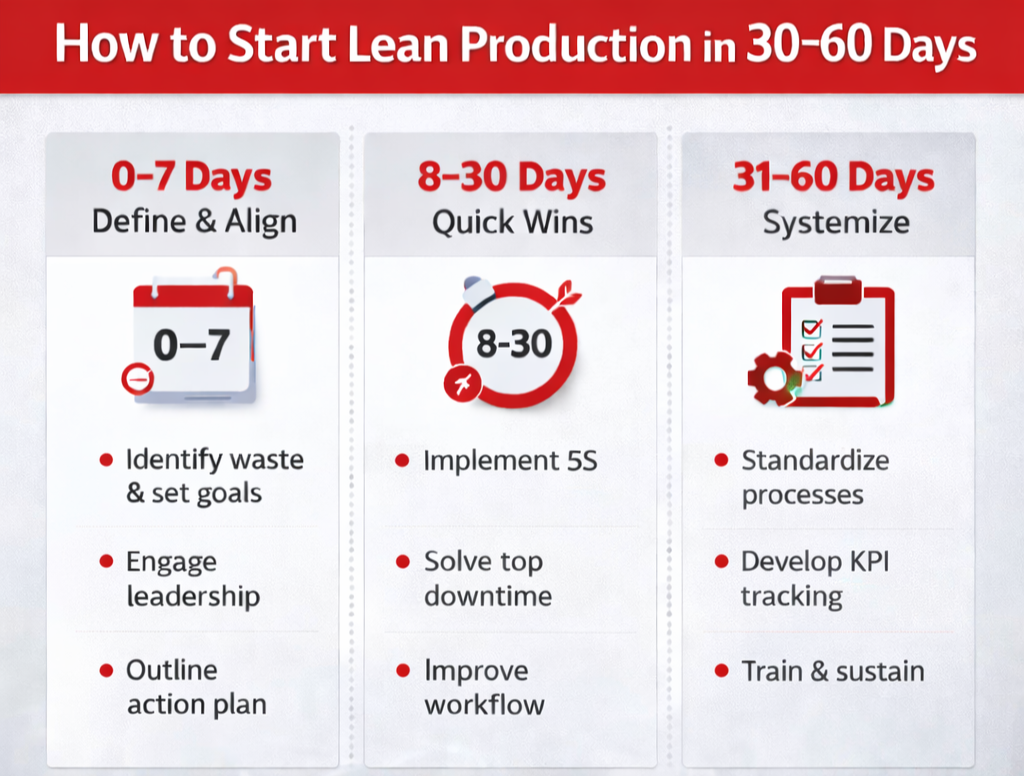
How to start Lean Production within 30–60 days
Days 0–7: Set the framework and align definitions
- Select 1 pilot line / 1 key machine (choose a high-impact area)
- Define machine states and downtime reasons so the team uses the same definitions
- Establish the minimum daily KPIs that must be visible: Downtime, Good Output, Defect/Scrap
Days 8–30: Deliver quick wins from the biggest losses
- Analyze and prioritize major losses by collecting downtime/defect data by cause, then focus on fixing the top 1–3 causes with the highest impact. This approach is also known as Pareto analysis, and it helps generate fast, measurable results.
- Run short Kaizen activities with clear owners and before-and-after metrics
- Create Standard Work for bottleneck steps or steps with recurring defects
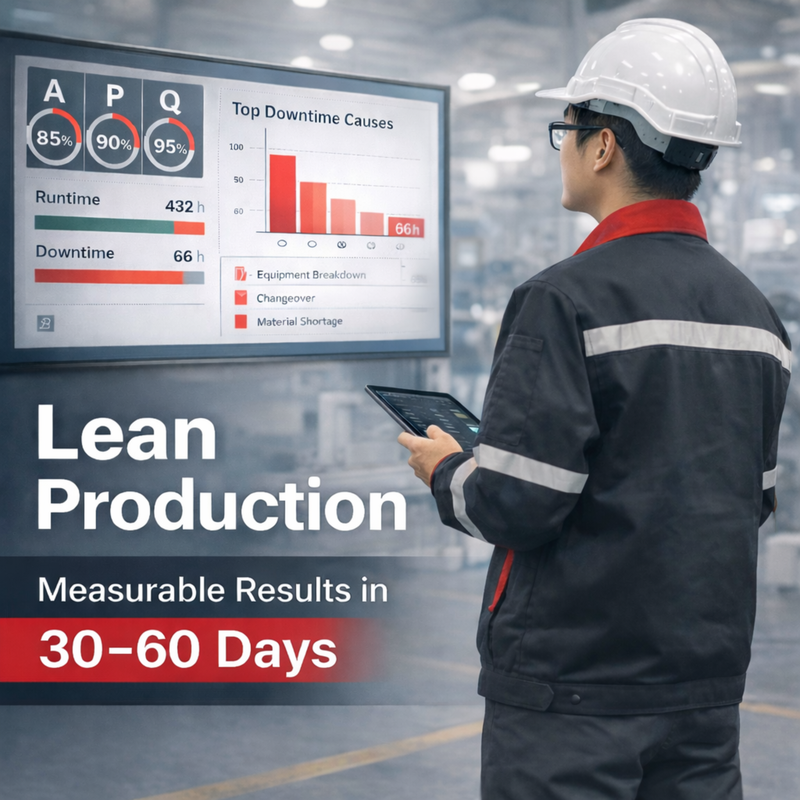
In large organizations, the key is to reduce debate and increase decision-making speed through a single shared data set. Using an OEE Monitoring system such as NIA Platform helps clearly visualize runtime, downtime, and major losses, reduces the burden of manual reporting, and improves data consistency across shifts.
Days 31–60: Elevate Lean into a management system
- Establish a short weekly performance review: KPI trends + action list + owner
- Lock in standards with Standard Work + training + lightweight but consistent audits
- Begin scaling to the next line using the same playbook (replication)
KPIs executives should measure to make Lean a “data-driven management system”
Lean becomes powerful when KPIs reflect the causes of outcomes, not only the final outcomes.
Main indicators
OEE and its components:
- Availability (related to downtime)
- Performance (related to speed loss / cycle time deviation)
- Quality (related to defects / rework)
Indicators that should be analyzed in more detail
- Downtime by reason (such as breakdown, changeover, waiting)
- Speed loss compared to standard cycle time
- Quality loss by defect type and time period
When KPIs are made easy to see and consistently available, managers can prioritize more accurately and reduce time spent on reporting, allowing teams to focus on problem-solving instead.
Common scenarios and Lean approaches
Case 1: High unplanned downtime, but problem-solving misses the real cause
Approach: Conduct a Pareto analysis of downtime reasons → focus on the top 1–2 causes → assign an owner + corrective action SLA
Expected result: Downtime minutes per shift decrease, and the availability trend improves
Case 2: Repeated defects occur, but root causes cannot be identified
Approach: Link defects to product model / time period / process step → establish standards for critical inspection points
Expected result: The top 3 defects decline continuously, and rework is reduced
Case 3: Production is running, but “slower than standard” has become normal
Approach: Compare actual cycle time with standard → analyze the conditions causing the slowdown → adjust standards / work methods
Expected result: Performance improves and good output increases without increasing overtime
FAQ
1) How is Lean Production different from OEE/TPM?
Lean focuses on reducing waste and improving flow, while OEE/TPM focuses on measuring and improving machine effectiveness. Most organizations use them together so Lean results can be measured and sustained.
2) Does Lean always have to start with 5S?
Not always. You can start with the biggest loss first, but 5S done in the right areas can quickly reduce hidden time loss and errors.
3) Which KPIs should managers track first?
Downtime, Good Output, and Defect/Scrap, because they clearly reflect lost time and the impact on delivery performance.
4) What types of factories is Lean suitable for?
It is suitable for factories with repetitive operations and goals related to process stability, reducing downtime/defects, and increasing productivity.
5) What are common obstacles in Thailand?
Misaligned definitions, inconsistent data, Lean being treated as an activity rather than linked to KPIs, and a lack of weekly follow-up systems.
6) How can results be prevented from slipping back?
There must be Standard Work, Training, and regular Review, along with clearly assigned Owners and clear deadlines.
Summary
Lean Production that is suitable for large organizations and factories is Lean that has been elevated into a management system with standards, clear KPIs, and a continuous review cycle. Start with a high-impact pilot, make the major losses visible using the same data across the organization, and then scale using the same playbook and standards. That is how results become sustainable and measurable.
If your organization wants to drive Lean Production systematically and measure results consistently, having clear runtime/downtime and loss data will enable faster decision-making and reduce the burden of manual reporting. The NIA Platform (OEE Monitoring System) can serve as the measurement foundation for a 30–60 day pilot and help extend continuous improvement systematically across the factory level.


